Shaping the Future with CELLUN
Technikum Laubholz, is working on the research project CELLUN – together with its project partners Deutsche Institute für Textil- und Faserforschung Denkendorf (DITF), ElringKlinger, Cordenka, CG Tec, and Fiber Engineering, as well as associated partners Porsche, FESTO, and manaomea.
CELLUN aims to develop sustainable, robust, and multifunctional composite materials based on cellulose for goods manufactured in Germany.
RESEARCH ASPECTS
CELLUN represents not only a material advancement but also embodies the ambition to make industrial production more sustainable and to pave the way for next-generation fiber-reinforced composites.
Challenges of Conventional Fibers
Currently used glass, carbon, basalt, and aramid fibers for textile reinforcement in composite materials exhibit high stiffness and tensile strength. However, their production and recycling involve significant energy consumption.
Recycling Process with Potential
In conventional recycling processes, these fibers experience a decline in quality with each cycle. CELLUN addresses this issue by developing an energy-efficient recycling approach aimed at preserving material quality as much as possible.
Replacing Glass and Carbon Fibers with CELLUN
CELLUN relies on renewable biopolymers and introduces an alternative approach to manufacturing industrial components. By replacing conventional glass or carbon fibers with cellulose-based reinforcement fibers, CELLUN enables not only more sustainable production but also leverages an almost inexhaustible raw material—cellulose.
Cellulose as a Key Resource
As the most abundant biopolymer on Earth, cellulose serves as a fundamental resource within the CELLUN composite. With an annual production of approximately 75 billion tonnes through biosynthesis, cellulose is considered a virtually unlimited raw material and a key element for sustainable material production.
ROLE OF TECHNIKUM LAUBHOLZ
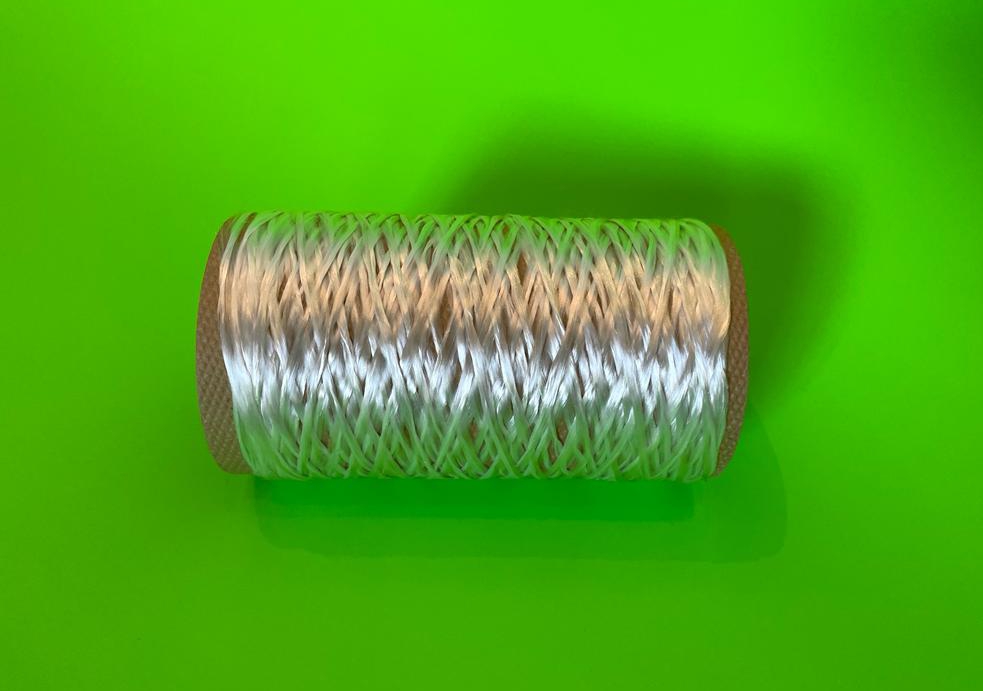
As the project progresses, Technikum Laubholz assumes a central role in close collaboration with DITF and Fiber Engineering. The fiber development specialists within the research field of fiber-based biopolymer materials focus intensively on establishing a fully closed material cycle for CELLUN after its end of life (EOL). Their research activities explore several promising approaches.
Thermal Reforming without Loss of Quality
One approach involves thermally reforming CELLUN components without any loss of quality. This enables existing CELLUN products to be reshaped into new forms after their service life without compromising performance. Thermal reforming thus opens up the possibility of extending product lifecycles while preserving original material properties.
Chemical Separation for Enhanced Recyclability
Another promising approach is the solvent-based material recycling of CELLUN, allowing it to be separated into its original constituents. The aim is to develop an efficient method to extract the individual components of the composite and reuse them as raw materials for new products. This recycling method helps minimize resource consumption and supports the creation of a closed-loop system for CELLUN.
TECHNOLOGICAL ASPECTS
Technological Synergies
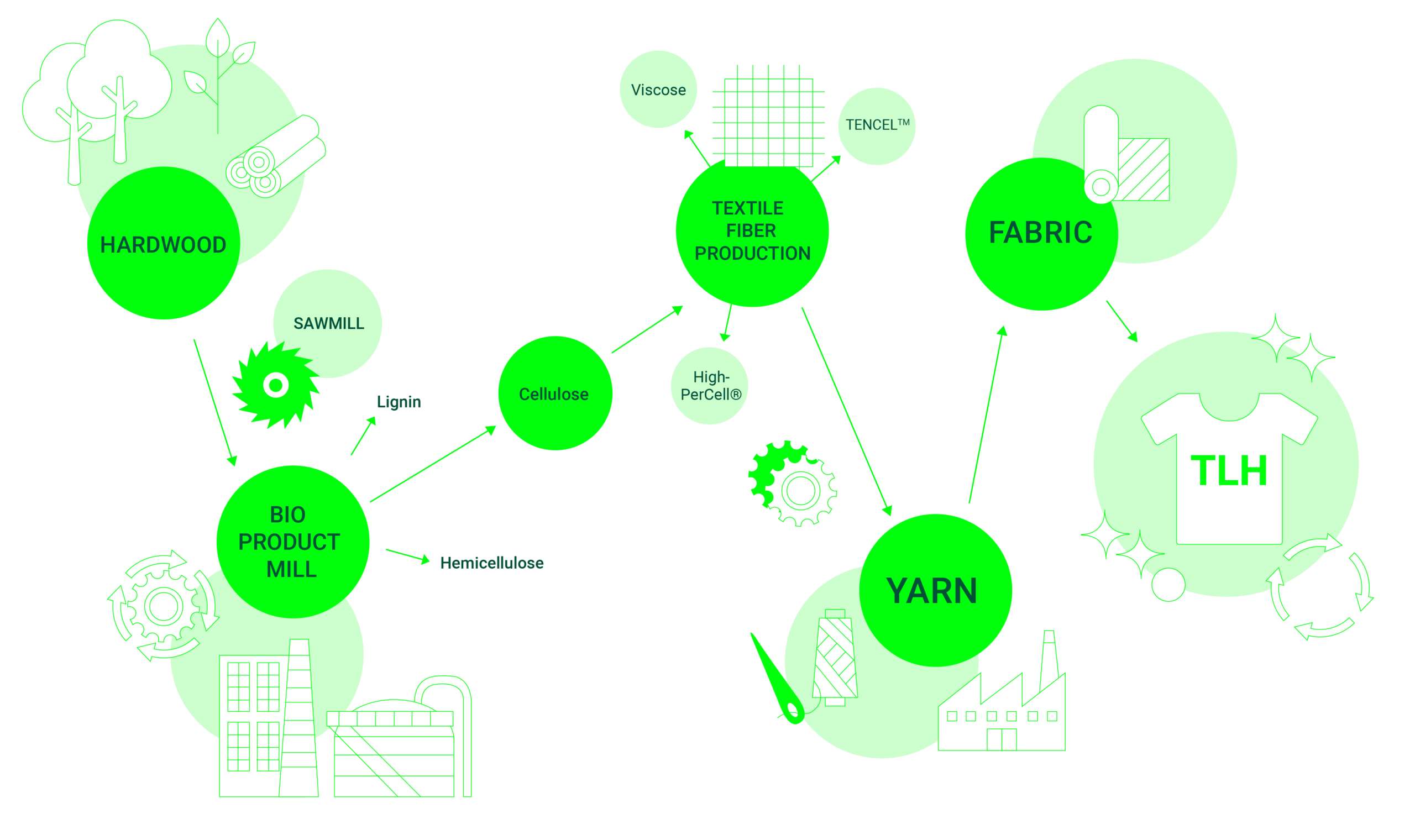
CELLUN composite materials are produced through a highly advanced process in which non-meltable cellulose fibers serve as reinforcement and are combined with thermoplastic, derivatized cellulose fibers acting as the matrix to form a hybrid roving. The reinforcement fibers are sourced from regenerated fibers by Cordenka as well as HighPerCell® cellulose fibers developed through the expertise of DITF.
Innovative Production Techniques
The hybrid rovings generated in the initial production phase can be transformed into versatile components via pultrusion or injection molding as short-fiber recyclates. Further processing into textile structures—such as woven or non-crimp fabrics—followed by compression molding into composite panels results in thermoplastic prepregs, also known as organosheets. These enable the large-scale industrial production of environmentally friendly components with strong technical performance.
SUSTAINABILITY

CELLUN represents a significant step forward in materials science and an innovative technology for sustainable production. Its manufacturing techniques demonstrate that innovation and environmental responsibility can go hand in hand.
Ecological Benefits
CELLUN goes beyond simply substituting petroleum-based plastics and offers substantial ecological added value. The biopolymers are derived from renewable resources, reducing the carbon footprint while also decreasing dependence on finite raw materials.
Contribution to a Circular Economy
CELLUN sets new standards in circular economy practices. Its recycling concepts for both reinforcement and matrix fibers allow the material to be reintegrated into the product cycle after its lifecycle ends. This not only promotes efficient resource use but also supports sustainable material recovery, ensuring that the CO₂ bound within CELLUN remains stored over an extended period.
Cost Efficiency and Environmentally Friendly Solutions
The use of cost-effective cellulose as a raw material not only ensures economic efficiency but also enables significant water savings during fiber production. In addition, the production of regenerated cellulose fibers is resource-efficient, as the solvents used are recycled and maintained within a closed loop. In this way, CELLUN underscores its environmental compatibility and commitment to sustainable manufacturing.
APPLICATIONS
CELLUN offers a wide range of applications across various sectors, including architecture, automotive, and the sports industry. In its current development phase, it represents a promising and innovative solution for composite material applications.
Automotive: Innovation in Vehicle Manufacturing
CELLUN has the potential to become a new standard in the automotive sector. Its unique combination of lightness and strength makes it an ideal choice for future vehicle production, positioning itself as a sustainable alternative for the automotive industry.
Lightweight Engineering: Maximum Performance with Minimal Weight
In lightweight engineering, CELLUN reaches its full potential. The materials are characterized by impressive strength at minimal mass, making them ideal for applications where every gram matters—whether in aerospace, marine construction, or the sports industry.
Architecture and Design: Sustainability Meets Aesthetics
In architecture and design, CELLUN opens up entirely new creative possibilities by enabling the realization of complex structures. Whether for sustainable building materials or avant-garde design objects, CELLUN combines ecological responsibility with aesthetic innovation.
Sports and Leisure Industry: Sustainable Performance in Motion
From sports equipment to outdoor products, CELLUN provides the right balance between performance and sustainability. The use of lightweight and durable materials makes a tangible difference for active individuals seeking environmentally conscious solutions.
OUTLOOK
The collaborative CELLUN project is currently in an intensive development phase, driven by financial support from the German Federal Ministry for Economic Affairs and Climate Action (BMWK). This support enables further research into the promising properties of CELLUN and paves the way toward industrial maturity, ensuring that its applications move beyond concept into real-world implementation.
Looking ahead, CELLUN presents highly promising prospects. Thermoplastic composites show strong potential for the serial production of ultra-lightweight hybrid structures. Further processing through overmolding techniques opens up new possibilities for manufacturing components with complex geometries and outstanding structural stiffness at minimal weight.
„The successful collaboration of all partners in the CELLUN project demonstrates that sustainable material innovations are no longer merely theoretical. The research achievements point toward a promising future in which CELLUN plays a central role in environmentally friendly and high-performance composite materials.“
— Dr. Rolf Moors, Head of Fiber-Based Biopolymer Materials, Technikum Laubholz.
Cellulose auf Holzbasis als Rohstoff für Verstärkungsfasern
- Günstige und erneuerbare Ressource aus holzbasierten Abfallströmen
- Regional in großen Mengen verfügbar
- Biobasiert und biologisch abbaubar
- Bekanntes Spinnverfahren (Trocken-Jet-Nass-Spinnen)





Das Verbundprojekt CELLUN, bestehend aus sechs Projektpartnern und einem assoziierten Partner, startete am 01.01.2022 und wird über das Technologietransfer-Programm Leichtbau des BMWK gefördert. Die Laufzeit beträgt drei Jahre, sodass der Abschluss des Projektes zum 31.12.2024 terminiert ist.
Assoziierte Partner:
Gefördert von: