

Enzymatic Processes as a Key to Sustainable Surfactants and Fine Chemicals
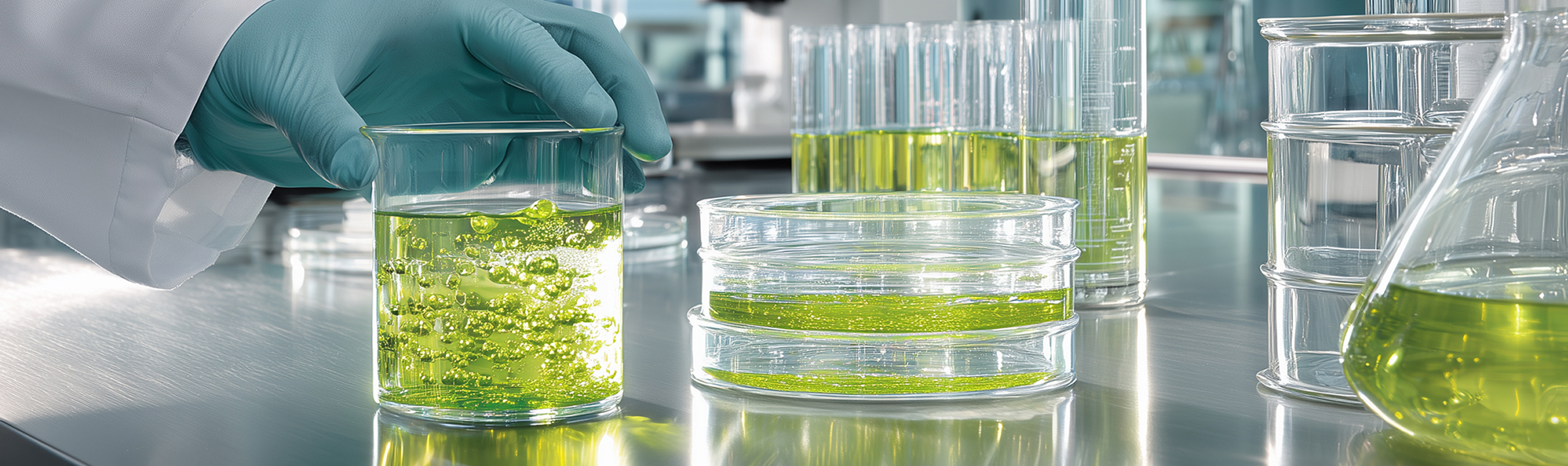
With the collaborative project SkaDES (Scaling of Enzymatic Platform Processes in Natural Deep Eutectic Solvents), the Technikum Laubholz, together with the Karlsruhe Institute of Technology and Hamburg University of Technology, is developing new approaches for more climate-friendly chemistry. The project aims to establish novel, environmentally friendly solvent systems derived from renewable resources for enzymatic reactions. The potential applications in the cosmetics, pharmaceutical, and food industries are wide-ranging.
The goal is to produce biosurfactants and fine chemicals in an energy- and resource-efficient manner and to further develop the processes so that they can be used economically and efficiently on an industrial scale. Instead of conventional chemical processes, enzymes are used as biological catalysts and Natural Deep Eutectic Solvents (NADES) as natural, environmentally friendly solvents.
*NADES are solvents composed entirely of natural, renewable, and non-toxic components
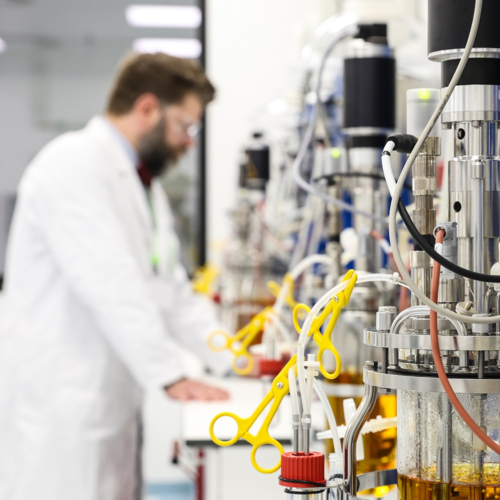
The reactions are carried out in scalable reactor systems and monitored by inline acquisition of key process parameters using Fourier transform infrared (FTIR) spectroscopy, enabling a precise understanding of enzyme behavior in these new media and optimization of reaction parameters. In addition, scalable purification processes (separation and reuse of enzymes and reaction components, as well as downstream processing of the products) are to be developed.

The reactions are carried out in scalable reactor systems and monitored by inline acquisition of key process parameters using Fourier transform infrared (FTIR) spectroscopy, enabling a precise understanding of enzyme behavior in these new media and optimization of reaction parameters. In addition, scalable purification processes (separation and reuse of enzymes and reaction components, as well as downstream processing of the products) are to be developed.
Technikum Laubholz
Technikum Laubholz
The Karlsruhe Institute of Technology (KIT) is a technical university of the state of Baden-Württemberg and a national research center within the Helmholtz Association. KIT was founded in 2009 through the merger of the University of Karlsruhe (TH) and the Research Center Karlsruhe. Prof. Dr.-Ing. Dirk Holtmann heads the sub-institute “Electrobiotechnology” at the “Institute of Bio- and Food Technology” at KIT. The Institute of Technical Biocatalysis at Hamburg University of Technology (TUHH), led by Prof. Dr. Andreas Liese, has been working for many years on the development of industrially relevant biotransformations and FTIR-based inline analytics.
Towards the end of the project, the partners will jointly develop and test a demonstrator that enables rapid transfer into industrial applications. Throughout the project, the research partners are supported by an industrial advisory board.
The project is funded through the program “Sustainable Renewable Resources” of the Federal Ministry for Rural Affairs, Agriculture and Regional Identity (BMLEH). The project sponsor is the Agency for Renewable Resources e.V. (FNR).
The Karlsruhe Institute of Technology (KIT) is a technical university of the state of Baden-Württemberg and a national research center within the Helmholtz Association. KIT was founded in 2009 through the merger of the University of Karlsruhe (TH) and the Research Center Karlsruhe. Prof. Dr.-Ing. Dirk Holtmann heads the sub-institute “Electrobiotechnology” at the “Institute of Bio- and Food Technology” at KIT.
The Institute of Technical Biocatalysis at Hamburg University of Technology (TUHH), led by Prof. Dr. Andreas Liese, has been working for many years on the development of industrially relevant biotransformations and FTIR-based inline analytics.
Towards the end of the project, the partners will jointly develop and test a demonstrator that enables rapid transfer into industrial applications. Throughout the project, the research partners are supported by an industrial advisory board.
The project is funded through the program “Sustainable Renewable Resources” of the Federal Ministry of Agriculture, Food and Regional Identity (BMLEH). The project management agency is the Agency for Renewable Resources e.V. (FNR).
News – SkaDes Project Meeting:
The SkaDes project has started!
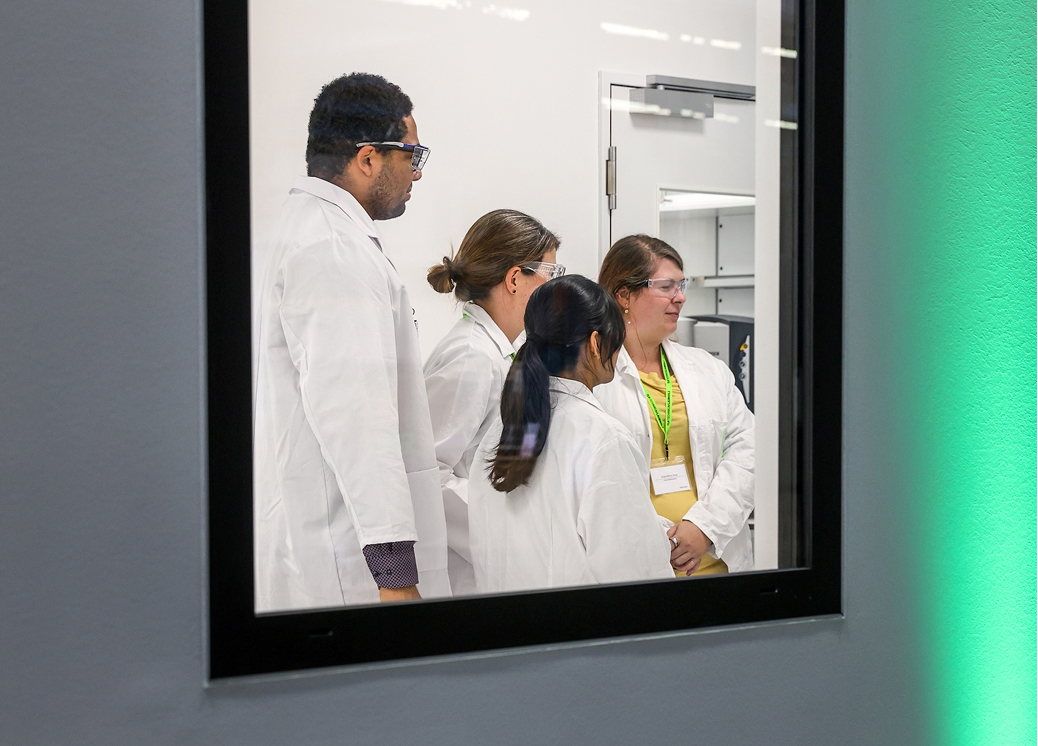
Together with our partners, we are researching scalable bioprocesses. At the project meeting held at TLH in Göppingen, we were able to exchange views on the current status of the subprojects and visit the recently inaugurated biolaboratory.
Your contact person
Katrin Salzmann
Project Management
katrin.salzmann@technikumlaubholz.de


